
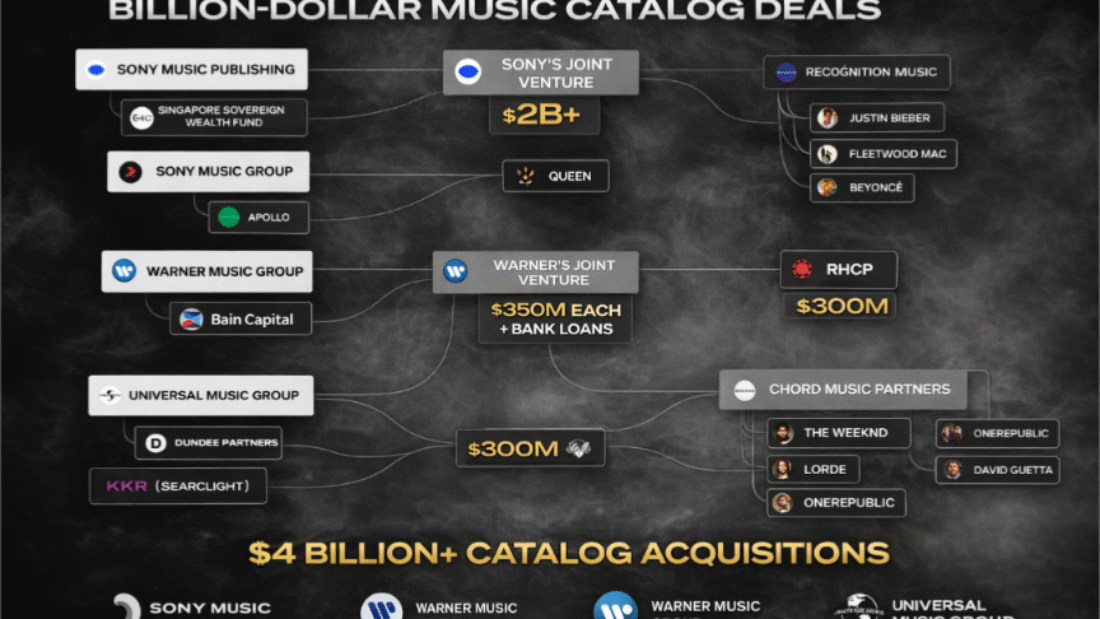
When headlines announce that Sony, Universal, or Warner Music just acquired a music catalog worth hundreds of millions or even billions of dollars, most people assume the labels are spending their own cash.
But that is no longer the full story.
Behind many of today’s biggest music acquisitions is something the public rarely sees: quiet institutional money from sovereign wealth funds, private equity firms, pension-backed investors, insurance capital, and Wall Street financing structures.
The modern music catalog boom is no longer driven by record labels alone. It is increasingly powered by global finance.
And the numbers behind these deals are enormous.
Music Catalogs Have Become Billion-Dollar Financial Assets
Over the past five years, music catalogs have evolved into one of the hottest alternative investment assets in the world.
Why?
Because songs generate recurring long-term income through:
Streaming royalties
Publishing royalties
Performance rights
YouTube monetization
Sync licensing for movies, games, TV, and advertising
Social media usage
Radio airplay
A successful song can continue generating revenue for 30, 40, or even 50 years.
According to Goldman Sachs, the global music industry is projected to surpass $45 billion in annual revenue before the end of the decade, with streaming remaining the dominant driver of growth.
Spotify alone paid out more than $10 billion to the music industry in a single year, showing why institutional investors now view music rights as predictable long-term cash-flow assets.
The result?
Wall Street entered the music business aggressively.
The Real Playbook Behind These Deals
Most major catalog acquisitions now follow a similar structure.
The investment firm provides the capital.
The music company provides industry expertise, relationships, administration, licensing, and operational management.
Together, they acquire catalogs and split revenues over time.
The public sees “Sony bought the catalog.”
But behind the scenes, the financing often comes from giant investment firms.
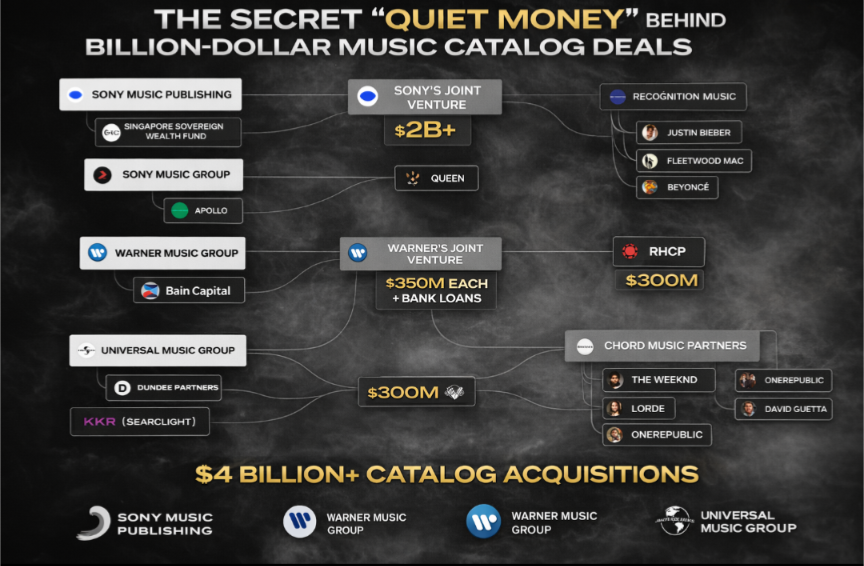
- Sony Music Publishing + Singapore’s Sovereign Wealth Fund (GIC)
One of the clearest examples is Sony Music’s partnership with Singapore’s sovereign wealth fund, GIC.
The partnership was created specifically to acquire premium music catalogs globally.
Reports indicate that GIC committed more than $2 billion toward music rights acquisitions alongside Sony. GIC itself manages an estimated portfolio worth more than $700 billion globally across multiple industries.
Sony contributes:
Global publishing expertise
Catalog administration
Licensing infrastructure
Industry relationships
GIC contributes:
Massive institutional capital.
This allows Sony to pursue billion-dollar acquisitions without using only its own balance sheet.
Recent reports linked this structure to Sony’s reported acquisition activity involving catalogs valued between $3.5 billion and $4 billion.
- Sony Music Group + Apollo Global Management
Sony also partnered with Apollo Global Management, one of the largest private equity and alternative asset firms in the world.
In 2024, Apollo announced a $700 million capital solution for Sony Music Group specifically to support investments in the music industry.
Apollo manages hundreds of billions in assets globally and viewed music rights as a strong alternative investment category due to stable streaming revenues.
This partnership reportedly helped support Sony’s broader acquisition ambitions, including activity around iconic catalogs like Queen and Pink Floyd.
The Queen catalog alone has reportedly been valued near or above $1 billion, while Sony’s Pink Floyd acquisition discussions were estimated around $400 million to $500 million.
This shows how modern music acquisitions increasingly resemble private equity transactions more than traditional record label deals.
- Warner Music Group + Bain Capital
Warner Music Group took a similar route by partnering with Bain Capital.
In 2025, Warner and Bain announced a joint venture capable of investing up to $1.2 billion into legendary music catalogs. Both parties contributed equal equity commitments while also leveraging financing from banks such as Goldman Sachs and Fifth Third Bank.
Warner handles:
Marketing
Distribution
Catalog administration
Industry operations
Bain provides:
Private equity capital
Financial structuring
Institutional investment resources
One of the first major targets linked to the venture was the Red Hot Chili Peppers catalog, reportedly valued at more than $300 million.
This demonstrates how catalog acquisitions are now being financed similarly to corporate buyouts.
- Universal Music + Chord Music Partners
Universal Music Group has also aligned itself with large-scale catalog acquisition structures.
Chord Music Partners was built specifically to acquire music rights using billions raised from institutional and private equity-backed financing.
Universal’s role extends beyond ownership. The company provides:
Catalog management
Licensing
Distribution
Royalty optimization
Global monetization infrastructure
This partnership model allows financial investors to participate in music ownership while relying on Universal’s expertise to maximize long-term returns.
Why Investors Suddenly Love Music
Streaming Made Revenues Predictable
Before streaming, music revenues were highly volatile because they depended heavily on physical sales.
Streaming changed everything.
Platforms like Spotify, Apple Music, YouTube Music, TikTok, and Amazon Music created recurring monthly consumption patterns.
Today, investors can forecast streaming performance almost like subscription-based technology businesses.
This predictability made music attractive to private equity firms.
Music Became “Recession Resistant”
During economic downturns, people still listen to music.
Even during COVID-19, streaming consumption remained strong globally.
That stability convinced investors that music rights could behave like defensive long-term assets similar to infrastructure or real estate.
Intellectual Property Became the New Oil
In the digital economy, ownership matters more than ever.
Music catalogs are intellectual property assets capable of generating revenue globally without manufacturing physical products.
This is why firms like:
Blackstone
Apollo
KKR
Bain Capital
BlackRock-linked funds
Insurance-backed investment groups
have all entered the music rights market aggressively.
In many ways, the future battle is no longer only about artists.
It is about ownership.
The Numbers Behind the Catalog Boom
Some of the industry’s biggest catalog transactions include:
Bob Dylan’s catalog reportedly sold for approximately $300 million to Universal Music.
Bruce Springsteen’s catalog reportedly sold for around $500 million to Sony.
Michael Jackson-related catalog assets were reportedly valued above $1.2 billion in Sony-related transactions.
David Bowie’s catalog reportedly sold for around $250 million.
Neil Young’s catalog transactions reportedly exceeded $150 million.
Queen’s catalog discussions reportedly approached or exceeded $1 billion.
These numbers explain why institutional investors now view music as a serious financial market.
What African Artists Should Learn From This
For African artists, this trend carries a major lesson.
Many artists still focus only on advances, quick payouts, and short-term visibility.
But globally, the real wealth is increasingly being built through ownership of masters, publishing rights, and catalogs.
A song is no longer just entertainment.
It is an asset.
This is especially important as African music continues growing internationally.
Afrobeats, Amapiano, Francophone African music, and other regional genres are expanding rapidly across streaming platforms.
The danger is that many African creators may undervalue their rights today without realizing how valuable catalogs could become in the future.
The Bigger Reality
The global music industry is quietly undergoing financial transformation.
What appears publicly as a “music company acquisition” is often actually a partnership between entertainment corporations and global finance institutions.
The labels provide expertise.
Wall Street provides the capital.
The public sees the headlines.
But the real engine behind today’s billion-dollar catalog boom is quiet money.
And this silent shift may completely redefine the future ownership structure of the global music business.