A lot of artists in Cameroon are dropping music every day, but many still don’t understand the codes that help their songs get tracked, registered, and paid properly.
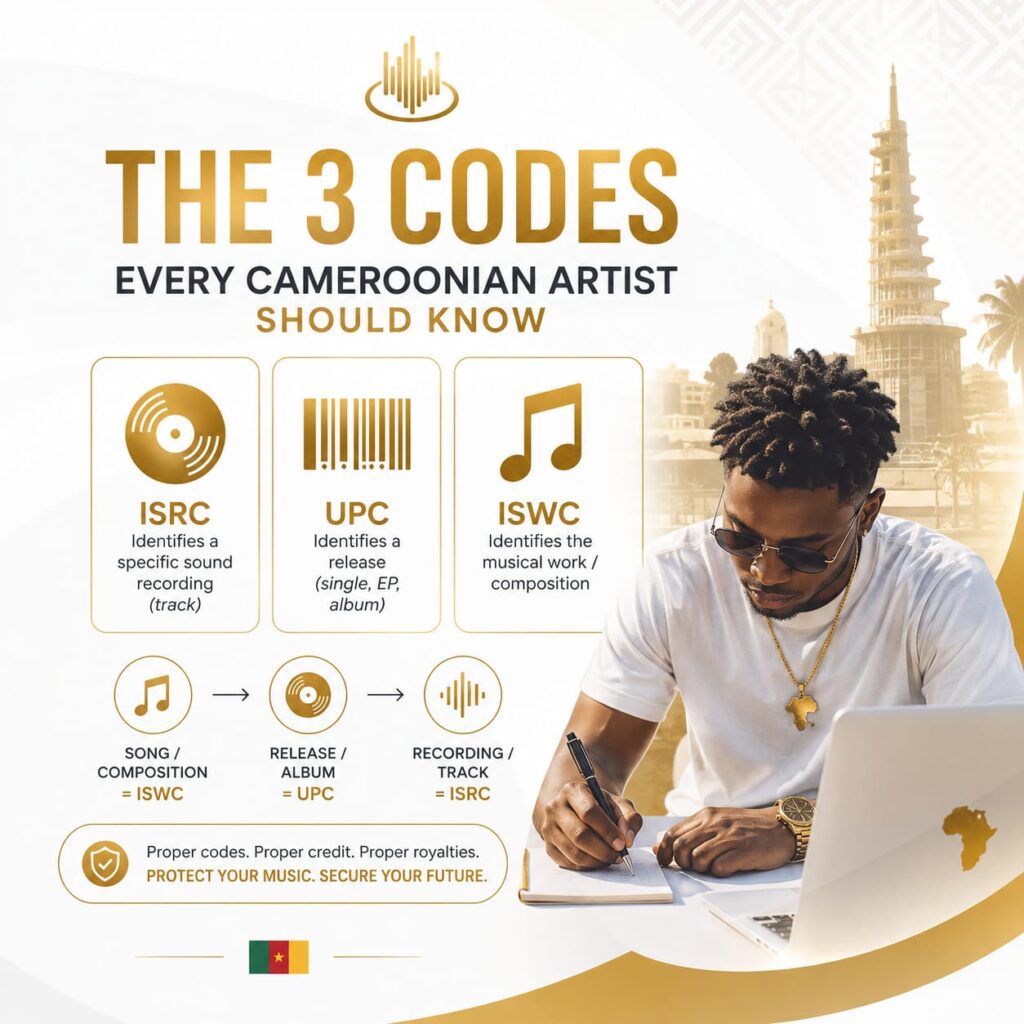
Behind every release on streaming platforms, there are three important codes working quietly in the background:
ISRC — This identifies a specific recording or track. Every version of a song has its own ISRC. UPC — This identifies the release itself, whether it’s a single, EP, or album. ISWC — This identifies the composition, meaning the actual song you wrote, including the lyrics and melody.
Think of it like this:
The song you wrote = ISWC The recording you uploaded = ISRC The project or release package = UPC
For many artists, producers, managers, and rights holders in Cameroon, missing royalties often comes down to something simple: incomplete or incorrect metadata. A song can perform well online and still fail to pay out properly if the information behind it is not correctly registered.
As Cameroon’s music scene keeps growing and reaching wider audiences, understanding ISRC, UPC, and ISWC is no longer just industry knowledge for labels and publishers. It is essential for every serious artist who wants their music to be properly protected and monetized.
Cameroon artists, managers, and music professionals: which of these three codes causes the most confusion for you? The ISRC, UPC, or ISWC?
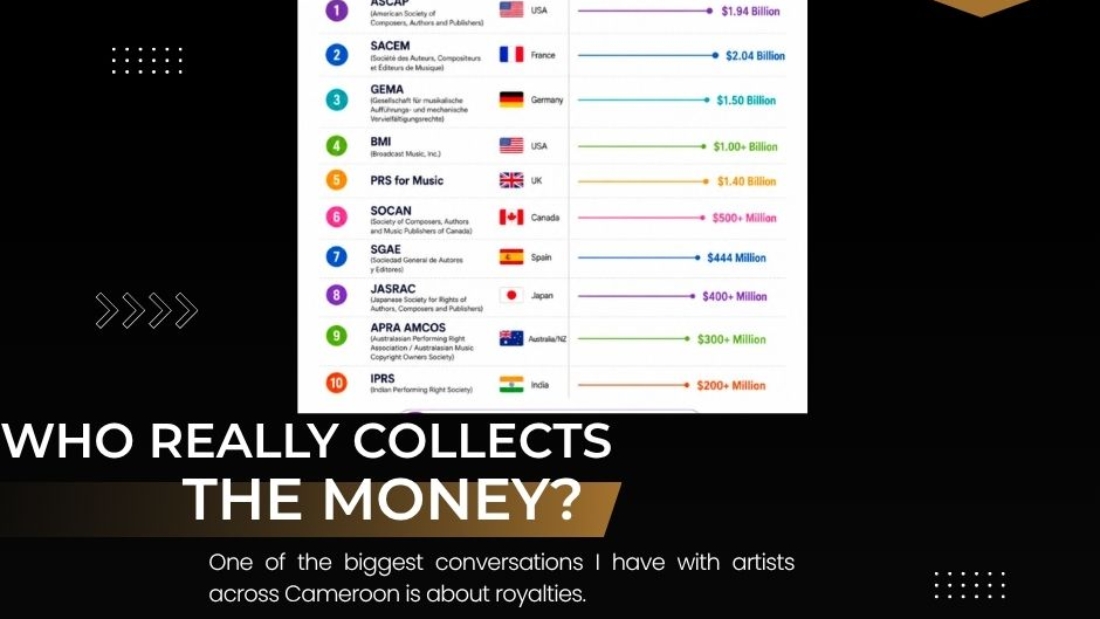
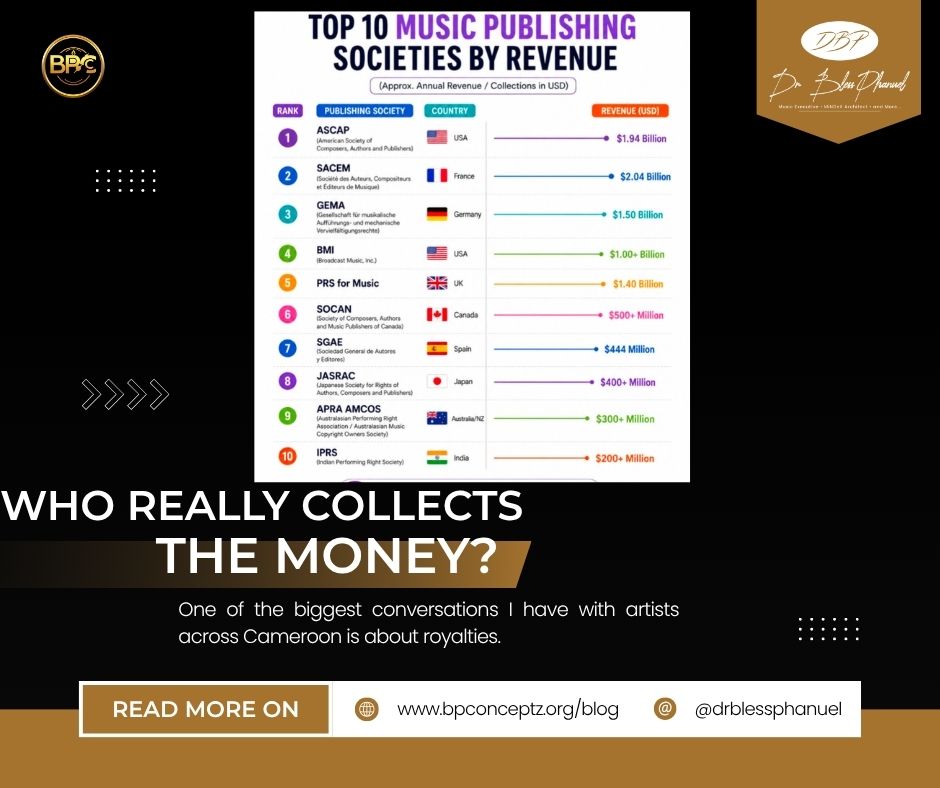
One of the biggest conversations I have with artists across Cameroon is about royalties.
An artist releases a song, gets thousands of streams, hears the song on radio, performs it at events, sees it circulating online, and then asks a simple question:
“Where is the money?”
The truth is that the global music industry runs on a system that many African artists still do not fully understand.
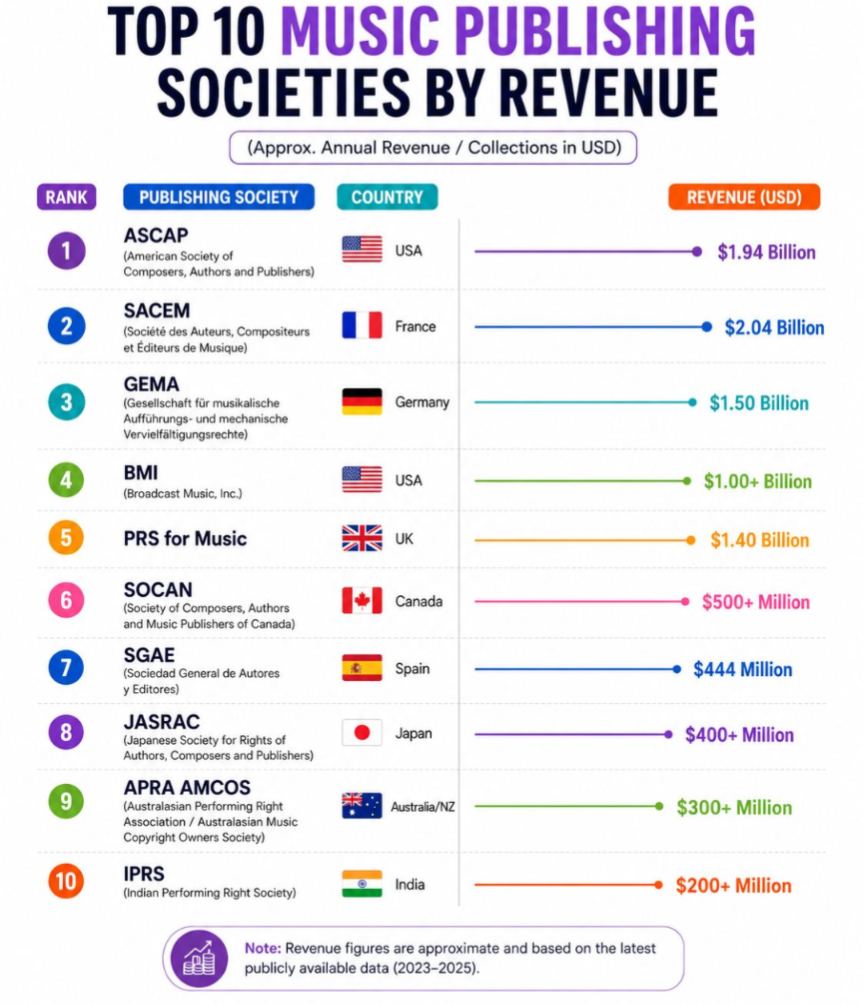
Behind every stream, broadcast, public performance, and license is a network of publishing societies and collective management organizations responsible for collecting and distributing royalties to songwriters, composers, and publishers.
Organizations such as ASCAP and BMI in the United States, SACEM in France, GEMA in Germany, PRS for Music in the United Kingdom, and IPRS in India collect billions every year on behalf of rights holders.
Yet many artists in our part of the world focus only on recording and releasing music without understanding the systems that generate long term income.
In many cases, artists are not poor because their music is not making money. They are losing money because they are disconnected from the structures that collect it.
As the music industry becomes increasingly digital, knowledge of publishing, copyright, neighboring rights, royalty collection, and music administration is becoming just as important as talent.
The artist who understands the business side of music has a significant advantage over the artist who focuses only on the creative side.
This is why I continue to advocate for music business education across Cameroon and Francophone Africa. We cannot build sustainable careers if we do not understand how value is created, tracked, collected, and distributed.
The future of African music will not only be shaped by great songs. It will also be shaped by creators who understand ownership, rights, and monetization.
The question is no longer whether your music can generate revenue.
The question is whether you understand where that revenue comes from and how to claim it.
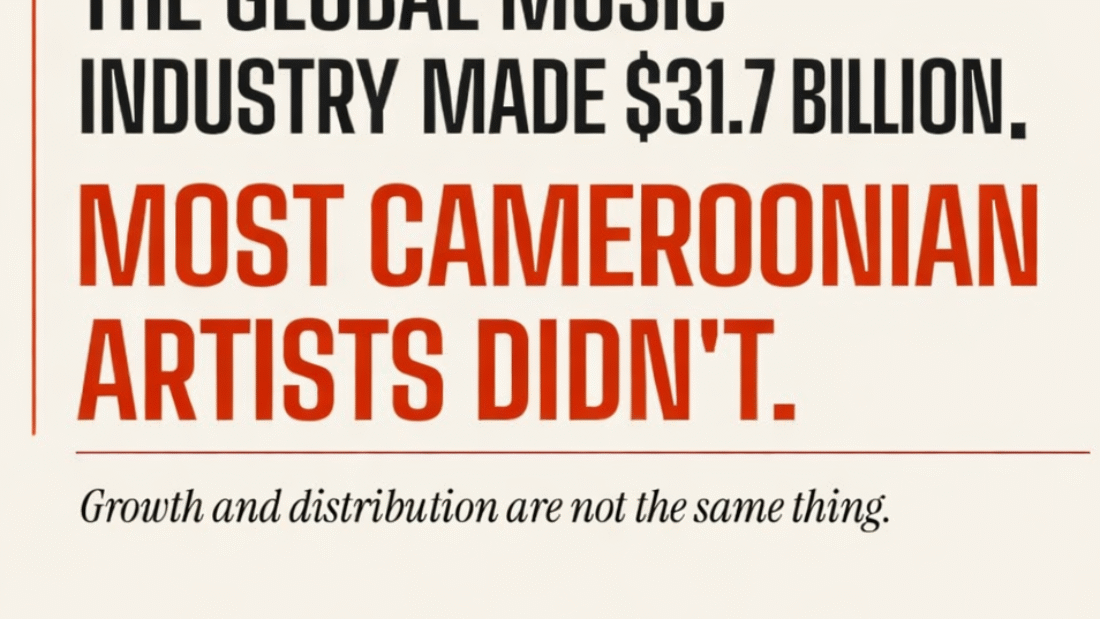
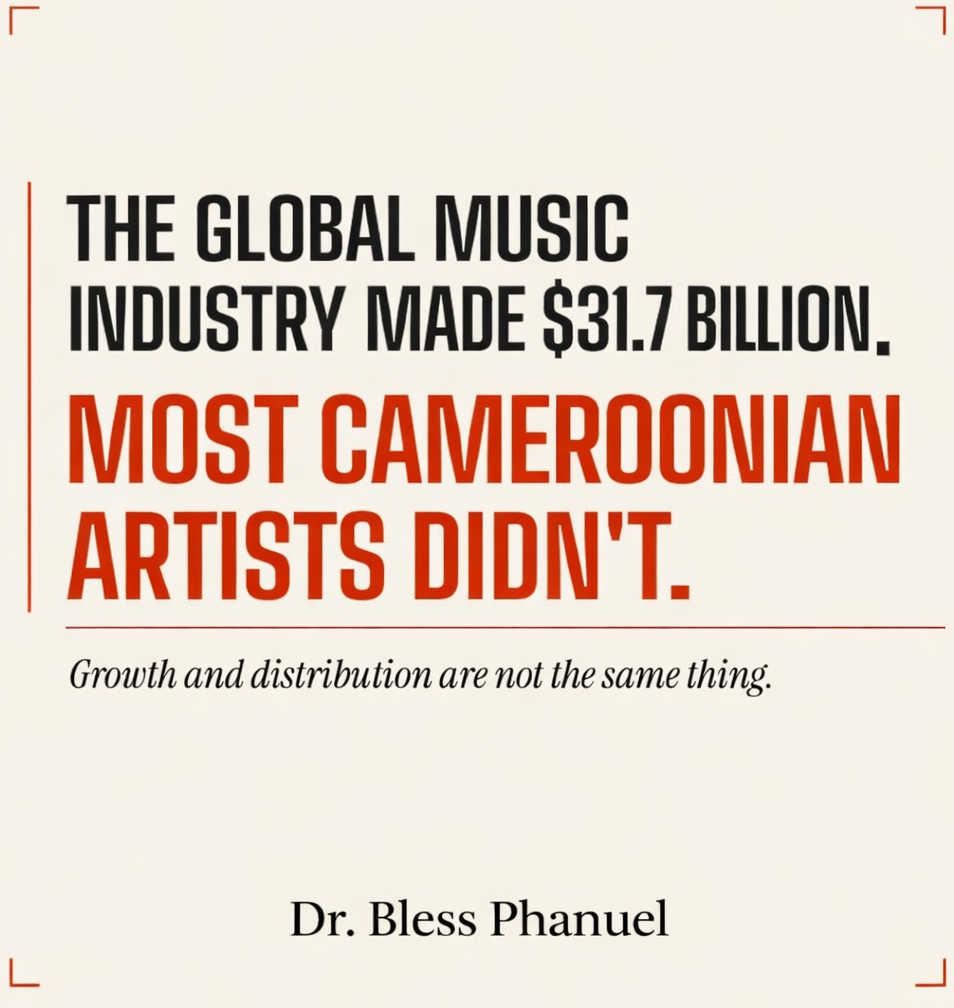
Last year, the global music industry generated approximately $31.7 billion in revenue.
At the same time, many artists around the world earned less than half a cent per stream from major streaming platforms.
Both statements are true.
And nowhere is this contradiction more visible than in emerging music markets like Cameroon.
Every year, headlines celebrate the growth of the music business. Streaming numbers are rising. Afrobeats is going global. African artists are getting international recognition. Major labels are expanding into Africa. The industry looks healthy from the outside.
But growth and distribution are two very different things.
The money entering the global music industry is not flowing equally to everyone participating in it. Most of the revenue moves toward the companies that control infrastructure, ownership, and distribution.
In simple terms: The people who own the system often make more money than the people creating the music.
The Reality Behind the Numbers
According to IFPI’s Global Music Report, recorded music revenues surpassed $31 billion globally in 2023, driven mainly by paid streaming subscriptions.
Spotify alone generated over €13 billion in annual revenue recently, with more than 600 million active users globally.
Yet many independent artists still struggle to survive financially from streaming income alone.
Why?
Because streaming economics heavily favor scale, ownership, and catalog control.
On average, Spotify pays between $0.003 and $0.005 per stream before royalties are divided among labels, distributors, publishers, managers, producers, and collaborators.
That means: 1 million streams may generate roughly $3,000 to $5,000 before splits and deductions.
For many independent African artists, even reaching one million streams consistently is already difficult.
Now imagine how small the final payout becomes after everyone in the chain takes their percentage.
The Cameroonian Reality Is Even More Difficult
In Cameroon, the monetization challenge is much deeper than streaming payouts alone.
The local music ecosystem still lacks strong monetization infrastructure.
Many artists are creating music, but very few are truly building sustainable music businesses.
Several major problems continue to affect the industry:
Limited royalty collection systems Weak publishing structures Low streaming penetration locally Poor copyright enforcement Lack of performance royalty transparency Limited sync licensing opportunities Few large scale investors in music infrastructure Low concert ticket purchasing culture Heavy dependence on free consumption
Many listeners consume music daily through WhatsApp shares, Bluetooth transfers, TikTok clips, YouTube reposts, or pirated downloads without any direct monetization reaching the artist.
This means that even popular songs may generate cultural impact without generating meaningful financial returns.
The Industry Rewards Infrastructure, Not Just Creativity
One difficult truth many artists avoid discussing is this:
The modern music industry was designed to reward ownership and infrastructure more than creation itself.
Labels own masters. Publishers control catalogs. Streaming platforms control audience access. Distributors manage delivery systems.
The artist, unless they own their rights, often becomes a participant inside someone else’s business structure.
This is why major labels and catalog owners continue generating enormous wealth even while many creators struggle financially.
A single successful catalog can generate recurring revenue for decades.
That is why companies like Sony, Universal, and Warner are spending billions acquiring music rights globally.
They understand something many artists still overlook: Ownership is the real long-term asset.
In Cameroon, Many Artists Focus on Visibility Before Ownership
A major challenge within the Cameroonian music industry is that many artists enter music chasing visibility before understanding business structure.
The conversations usually focus on: How to trend How to go viral How to get signed How to gain followers How to shoot better videos
All these things matter.
But very few conversations focus on: Publishing Master ownership Royalty systems Metadata management Licensing Catalog valuation Long-term rights ownership
As a result, many artists optimize for short-term attention instead of long-term financial sustainability.
Streaming Alone Cannot Save Most Cameroonian Artists
Even globally, streaming revenue alone only works significantly at very large scale.
For many Cameroonian artists, sustainable income will likely require combining multiple revenue streams such as:
Live performances Brand partnerships Merchandise YouTube monetization Publishing royalties International collaborations Licensing opportunities Fan communities Direct-to-fan sales Digital content businesses
The problem is that many artists are entering the industry without understanding how these systems work together.
The Knowledge Gap Is Still One of the Biggest Problems
Cameroon has talent. That has never been the issue.
The bigger problem is the lack of industry education and structural understanding.
Many artists still do not fully understand: Who owns what How royalties flow How contracts work How publishing works How global distribution systems operate How catalogs gain value over time
Without this knowledge, artists often sign away rights too early or build careers without ownership foundations.
And in a digital economy, ownership matters more than ever.
The Bigger Conversation Africa Needs
Africa’s music industry is growing rapidly, but growth alone does not guarantee creator wealth.
If African artists and executives do not build stronger ownership structures locally, much of the long-term value created by African music may eventually be controlled externally by foreign companies, investors, and catalog acquisition firms.
The global industry already understands the future value of music rights.
The question is whether African creators understand it too.
Final Thought
The global music industry may be generating billions, but that does not automatically mean artists are financially thriving.
Especially in Cameroon, the issue is not only talent or even audience attention.
The deeper challenge is monetization structure, ownership, and industry education.
Understanding how the system works may not change it overnight.
But it changes what artists choose to optimize for.
And in today’s music business, what you own may matter more than how famous you are.
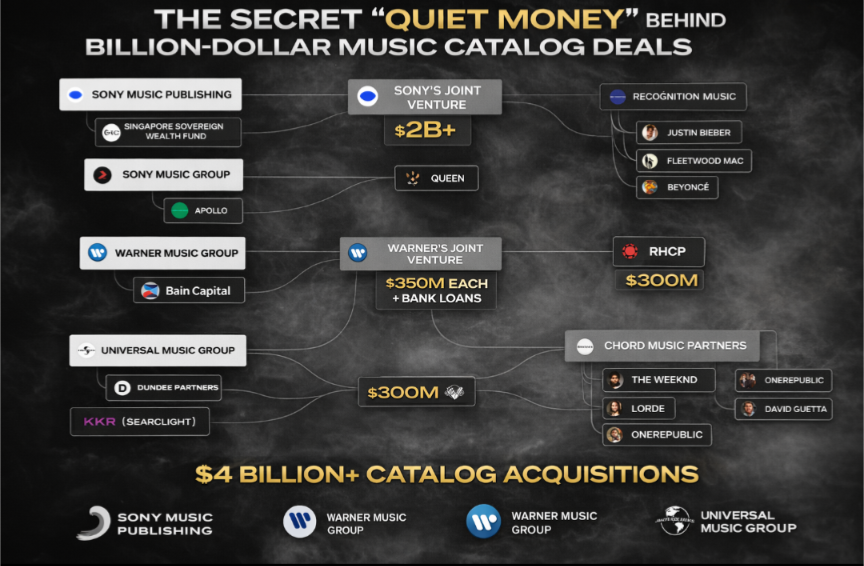
When headlines announce that Sony, Universal, or Warner Music just acquired a music catalog worth hundreds of millions or even billions of dollars, most people assume the labels are spending their own cash.
But that is no longer the full story.
Behind many of today’s biggest music acquisitions is something the public rarely sees: quiet institutional money from sovereign wealth funds, private equity firms, pension-backed investors, insurance capital, and Wall Street financing structures.
The modern music catalog boom is no longer driven by record labels alone. It is increasingly powered by global finance.
And the numbers behind these deals are enormous.
Music Catalogs Have Become Billion-Dollar Financial Assets
Over the past five years, music catalogs have evolved into one of the hottest alternative investment assets in the world.
Why?
Because songs generate recurring long-term income through: Streaming royalties Publishing royalties Performance rights YouTube monetization Sync licensing for movies, games, TV, and advertising Social media usage Radio airplay
A successful song can continue generating revenue for 30, 40, or even 50 years.
According to Goldman Sachs, the global music industry is projected to surpass $45 billion in annual revenue before the end of the decade, with streaming remaining the dominant driver of growth.
Spotify alone paid out more than $10 billion to the music industry in a single year, showing why institutional investors now view music rights as predictable long-term cash-flow assets.
The result? Wall Street entered the music business aggressively.
The Real Playbook Behind These Deals
Most major catalog acquisitions now follow a similar structure.
The investment firm provides the capital. The music company provides industry expertise, relationships, administration, licensing, and operational management.
Together, they acquire catalogs and split revenues over time.
The public sees “Sony bought the catalog.” But behind the scenes, the financing often comes from giant investment firms.
Sony Music Publishing + Singapore’s Sovereign Wealth Fund (GIC)
One of the clearest examples is Sony Music’s partnership with Singapore’s sovereign wealth fund, GIC.
The partnership was created specifically to acquire premium music catalogs globally.
Reports indicate that GIC committed more than $2 billion toward music rights acquisitions alongside Sony. GIC itself manages an estimated portfolio worth more than $700 billion globally across multiple industries.
Sony contributes: Global publishing expertise Catalog administration Licensing infrastructure Industry relationships
GIC contributes: Massive institutional capital.
This allows Sony to pursue billion-dollar acquisitions without using only its own balance sheet.
Recent reports linked this structure to Sony’s reported acquisition activity involving catalogs valued between $3.5 billion and $4 billion.
Sony Music Group + Apollo Global Management
Sony also partnered with Apollo Global Management, one of the largest private equity and alternative asset firms in the world.
In 2024, Apollo announced a $700 million capital solution for Sony Music Group specifically to support investments in the music industry.
Apollo manages hundreds of billions in assets globally and viewed music rights as a strong alternative investment category due to stable streaming revenues.
This partnership reportedly helped support Sony’s broader acquisition ambitions, including activity around iconic catalogs like Queen and Pink Floyd.
The Queen catalog alone has reportedly been valued near or above $1 billion, while Sony’s Pink Floyd acquisition discussions were estimated around $400 million to $500 million.
This shows how modern music acquisitions increasingly resemble private equity transactions more than traditional record label deals.
Warner Music Group + Bain Capital
Warner Music Group took a similar route by partnering with Bain Capital.
In 2025, Warner and Bain announced a joint venture capable of investing up to $1.2 billion into legendary music catalogs. Both parties contributed equal equity commitments while also leveraging financing from banks such as Goldman Sachs and Fifth Third Bank.
Warner handles: Marketing Distribution Catalog administration Industry operations
Bain provides: Private equity capital Financial structuring Institutional investment resources
One of the first major targets linked to the venture was the Red Hot Chili Peppers catalog, reportedly valued at more than $300 million.
This demonstrates how catalog acquisitions are now being financed similarly to corporate buyouts.
Universal Music + Chord Music Partners
Universal Music Group has also aligned itself with large-scale catalog acquisition structures.
Chord Music Partners was built specifically to acquire music rights using billions raised from institutional and private equity-backed financing.
Universal’s role extends beyond ownership. The company provides: Catalog management Licensing Distribution Royalty optimization Global monetization infrastructure
This partnership model allows financial investors to participate in music ownership while relying on Universal’s expertise to maximize long-term returns.
Why Investors Suddenly Love Music
Streaming Made Revenues Predictable
Before streaming, music revenues were highly volatile because they depended heavily on physical sales.
Streaming changed everything.
Platforms like Spotify, Apple Music, YouTube Music, TikTok, and Amazon Music created recurring monthly consumption patterns.
Today, investors can forecast streaming performance almost like subscription-based technology businesses.
This predictability made music attractive to private equity firms.
Music Became “Recession Resistant”
During economic downturns, people still listen to music.
Even during COVID-19, streaming consumption remained strong globally.
That stability convinced investors that music rights could behave like defensive long-term assets similar to infrastructure or real estate.
Intellectual Property Became the New Oil
In the digital economy, ownership matters more than ever.
Music catalogs are intellectual property assets capable of generating revenue globally without manufacturing physical products.
This is why firms like: Blackstone Apollo KKR Bain Capital BlackRock-linked funds Insurance-backed investment groups
have all entered the music rights market aggressively.
In many ways, the future battle is no longer only about artists. It is about ownership.
The Numbers Behind the Catalog Boom
Some of the industry’s biggest catalog transactions include:
Bob Dylan’s catalog reportedly sold for approximately $300 million to Universal Music.
Bruce Springsteen’s catalog reportedly sold for around $500 million to Sony.
Michael Jackson-related catalog assets were reportedly valued above $1.2 billion in Sony-related transactions.
David Bowie’s catalog reportedly sold for around $250 million.
Neil Young’s catalog transactions reportedly exceeded $150 million.
Queen’s catalog discussions reportedly approached or exceeded $1 billion.
These numbers explain why institutional investors now view music as a serious financial market.
What African Artists Should Learn From This
For African artists, this trend carries a major lesson.
Many artists still focus only on advances, quick payouts, and short-term visibility.
But globally, the real wealth is increasingly being built through ownership of masters, publishing rights, and catalogs.
A song is no longer just entertainment. It is an asset.
This is especially important as African music continues growing internationally.
Afrobeats, Amapiano, Francophone African music, and other regional genres are expanding rapidly across streaming platforms.
The danger is that many African creators may undervalue their rights today without realizing how valuable catalogs could become in the future.
The Bigger Reality
The global music industry is quietly undergoing financial transformation.
What appears publicly as a “music company acquisition” is often actually a partnership between entertainment corporations and global finance institutions.
The labels provide expertise. Wall Street provides the capital.
The public sees the headlines. But the real engine behind today’s billion-dollar catalog boom is quiet money.
And this silent shift may completely redefine the future ownership structure of the global music business.
Whenever artists are asked about their biggest challenge, the answer is almost always the same: money. Many believe that if they had enough financial support, their careers would automatically take off.
But looking closely at the Cameroonian music industry today, it becomes obvious that money is not always the real issue. In many cases, the deeper problem is the lack of structure, direction, and proper understanding of the music business.
The Biggest Problem Most Artists Face in Cameroon Is Not Money
Cameroon is full of talented artists. Every day, new voices emerge with incredible creativity and potential. Yet many of these artists struggle to grow, not because they lack talent, but because they enter the industry without preparation.
A lot of artists focus only on recording songs and shooting videos while ignoring the business side of music. They do not understand distribution, royalties, branding, marketing, audience building, networking, or release strategy. Some release music consistently but remain invisible because there is no clear structure behind their efforts.
This creates frustration.
Many artists eventually begin to blame the industry, the audience, bloggers, promoters, or even streaming platforms without first asking whether they truly understand how the industry works.
The reality is that music today is not just talent. Music is also business.
Before releasing music professionally, artists should learn at least the basics of the industry. Understanding how to position a brand, promote a release, build a fanbase, and manage opportunities can make a huge difference, even with limited resources.
In Cameroon especially, many artists are waiting for sponsors, investors, or overnight breakthroughs while neglecting personal development and industry education. Yet knowledge is what helps artists make smart decisions with the little resources they already have.
Money is important, yes. But money without structure often disappears without results. We have seen artists invest heavily into projects that create temporary noise but no long term impact because there was no proper strategy behind the investment.
The artists who survive and grow are not always the most talented. In many cases, they are the most informed, disciplined, and intentional.
Cameroon has enough talent to compete globally. What the industry needs now is more structure, more education, and more artists who understand that building a music career requires both creativity and strategy.
The conversation is important because solving the problems of the Cameroonian music industry will require honesty and collective reflection.
Do you think money is truly the biggest challenge artists face in Cameroon, or is the real issue lack of knowledge, structure, and industry understanding?
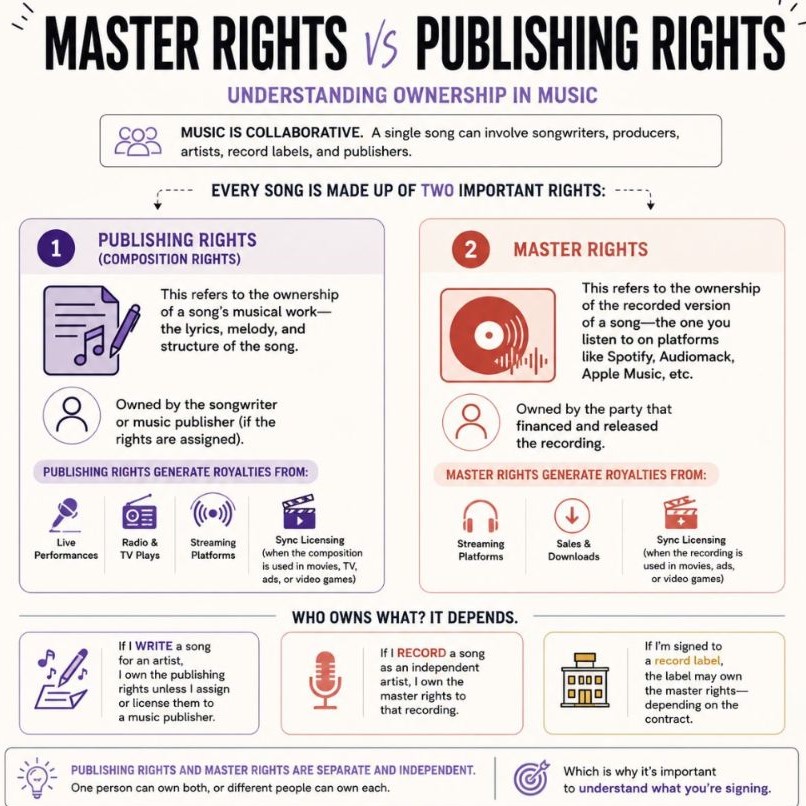
One of the biggest problems in Cameroon’s music industry today is that many artists, producers, and songwriters still do not fully understand what they actually own after creating a song.
Because of this, many creatives lose royalties, publishing income, master ownership, and long-term revenue opportunities simply because they sign agreements they do not fully understand.
Music ownership is not always simple because music is collaborative. A single song can involve songwriters, producers, artists, labels, publishers, distributors, and engineers.
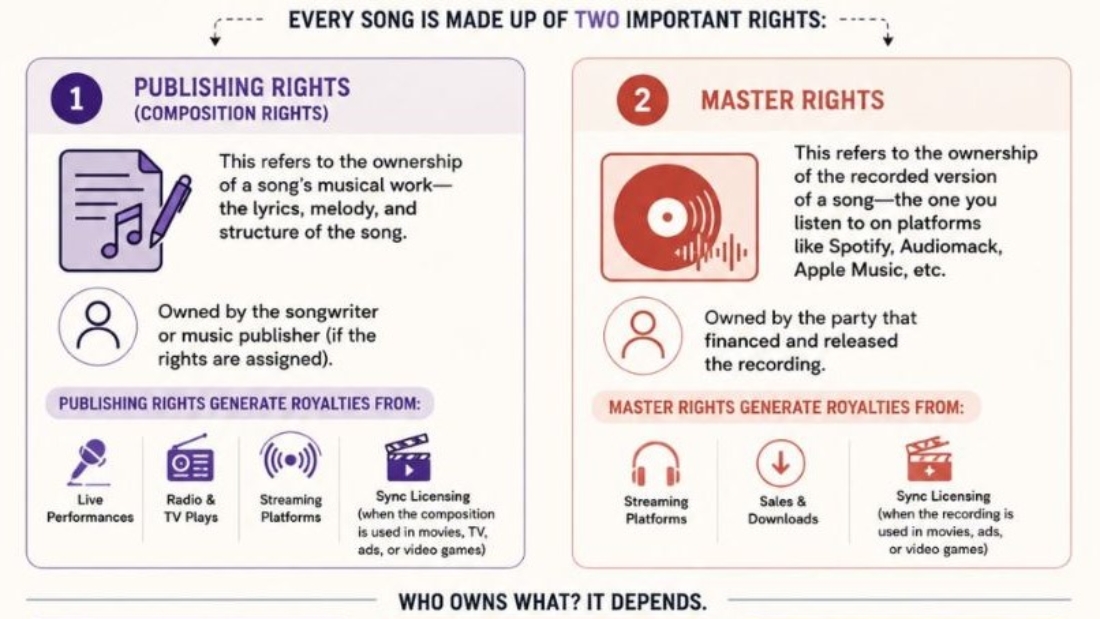
Every commercially released song is built around two major rights:
Publishing Rights
Publishing rights relate to the musical composition itself:
Lyrics
Melody
Songwriting structure
These rights usually belong to the songwriter or publisher and generate royalties from radio plays, streaming platforms, TV broadcasts, live performances, and licensing.
Master Rights
Master rights relate to the final recorded version of the song heard on Spotify, Apple Music, Audiomack, Boomplay, and YouTube.
The owner of the master controls how the recording is distributed, monetized, and licensed commercially.
Master rights generate income from streaming revenue, digital sales, YouTube monetization, and sync licensing.
One important thing every creative in Cameroon must understand is this:
Publishing rights and master rights are completely different rights.
You can own one without owning the other.
This is why understanding contracts before signing them is extremely important.
Many creatives across Cameroon are still signing deals without fully understanding:
What rights they are giving away
What royalties they deserve
What ownership they are keeping long-term
As Cameroon’s music industry continues to grow, music business education and rights awareness will become more important than ever.